
MAGICAL REALISM
Solo Exhibition, Abend Gallery 2025
Many of us are familiar with the term magical realism from the literary genre. Magical realist fiction portrays magical events in realistic settings. Perhaps you have read books in this genre like One Hundred Years of Solitude by Gabriel Garcia Marquez or Babel by R.F. Kuang. Magical realism often uses fantastical narratives to comment on our reality. These strange and beautiful stories work within our reality so we will question our lived experiences. In a similar vein, this series of paintings plays with our sense of reality so viewers will consider the plants and animals in our environment through a new lens. This body of work also contains a literal reference to the terms “magical” and “realism” because these are realistically painted artworks that capture magical subjects.
Humans have worshipped the animals and plants that surround them for millennia. Our myths originate from the truly strange and beautiful creatures among us. My paintings attempt to capture that sense of wonder about the natural world that has always imbued our legends. Whether it is something as small as a sea slug or as majestic as an elephant, each work depicts reverence for these creatures. I am attempting to highlight the narrow gap between mythology and reality. By exhibiting paintings of both real and imagined creatures, I want to blur the division between reality and fiction. I made it difficult to distinguish between the mythical and real creatures in this show so viewers would find themselves puzzling a little and realizing that reality can be even stranger than fiction. When we tap into our sense of awe for the natural world, we will also find our ability to love and protect it. I created the work for this exhibiton while I was pregnant and during the early days of raising my son, so many of the paintings reference legends around fertility and the cycle of life. I hope these works remind you of the truly extraordinary world we all share.

ANIMAL KINGDOM
Solo Exhibition, Abend Gallery 2023
The title for this exhibition, Animal Kingdom, is both a reference to the taxonomic term kingdom and an allusion to a fantasy scenario where animals have taken over the world. Each work has a unique approach to presenting this world. I began to wonder, what would an elegant portrait of a bear or a lemur look like? Or, given the chance, what might a buffalo do in an art museum when confronted with a painting like American Progress that glorifies its extermination? In a sense, these works are all examples of revisionist history because they take historical human centric visual narratives and replace them with animal protagonists.
I gained inspiration for this work both from my own deep love of animals, and from my observations of our changing planet. For many years of my life, I have been some form of vegetarian or vegan. These paintings ask viewers to look at animals with a sense of dignity and respect. Several of the paintings in this series follow traditions of conventional portraiture as a tool to elevate animals. They also demonstrate a sense of anger and frustration in animals. This can be seen in paintings that show animals walking over famous sculptures or destroying iconic artworks. I also enjoyed playing with humorous and absurd narratives in these works. Though this work has a fantastical element to it, real life examples abound. We all watched with wonder and fascination how quickly nature wanted to take back spaces from us during the Covid-19 lockdown. And, as I write this statement, orcas are attacking yachts in Spain, an elk punched a hole in the tire of an obnoxious tourist in Yellowstone, and an infamous otter is stealing surf boards to catch its own waves in Santa Cruz.
I walk in the footsteps of other artists working to reimagine the role of animals. One of my favorite 19th century artists is Rosa Bonheur, who gained unprecedented fame for her accurate and powerful paintings of animals. My former graduate school mentor and advisor Peter Zokosky has a fascinating series of chimpanzee portraits, fellow Colorado artist Mai Wyn routinely describes the intentional dignity and regality she seeks in her animal portraits, and the contemporary painter Martin Wittfooth creates moving portraits of animals caught up in postapocalyptic nightmares. Each of these artists has inspired me in one way or another. I wanted to add to this ongoing conversation with my own observations. I attempted to push the notion of a regal animal portrait and ponder the visual possibilities of animals taking over prestigious palaces, galleries, and museums. In our society, we have been so afraid of anthropomorphizing animals that we have over corrected. We often fail to see animals as equally emotional and sentient beings. My hope is that viewers walk away from this exhibition thinking just a little differently about how we should regard our fellow creatures on this planet.
DREAMS FROM THE ANTHROPOCENE
Solo Exhibition, Abend Gallery 2022
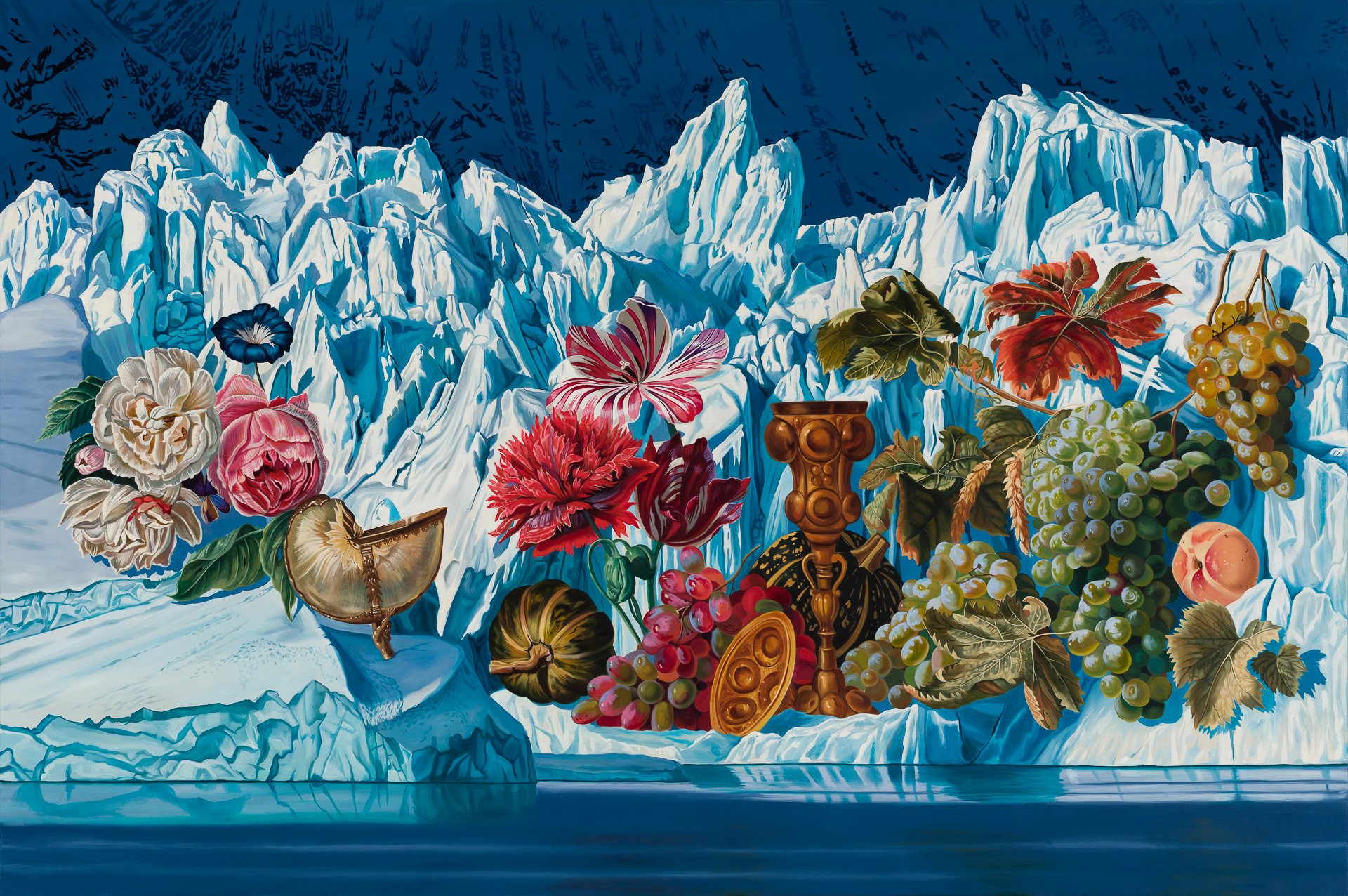
We now live in a new geological epoch known as the “Anthropocene.” This period refers to the significant human impact on species extinction and the climate since 1950. I chose to integrate imagery from 17th century Dutch still life paintings because this genre developed in tandem with trade, colonialism, market capitalism, and consumption. These traditional paintings displayed both local and global riches in the form of food items, Chinese porcelain, Persian carpets, and even citrus fruits imported from the Mediterranean. During the height of the “Tulip Mania” in the Netherlands, a tulip market bubble fueled by frenzied purchases of rare bulbs, some tulips cost the same amount as a home. By working within and against these traditional methods, I call these historical foundations into question and ask viewers to look at art history in a new light. Juxtaposing icebergs with imagery from traditional Dutch paintings also asks us to examine how the historical relationship between humans and the environment has generated a legacy of a warming planet.
My work also responds to the surrealist tradition. The surrealist movement offered a deep critique of the nature of reality and the relationship between our dreaming and waking states. Surrealists combined Freudian theories of the subconscious with the post WWI Dadaist rejection of rationality to generate a new take on reality. Many surrealist artists randomly combined cutout pictures to create unusual dream-like collages. They would also play with distortions in scale and perspective. Like the surrealist artists that came before my time, I also enjoy manipulating scale to create a sense of unreality and distortion. However, rather than seeking out random free association like the surrealists, I am intentionally combining images to generate a critical dialogue around climate change. By using dream like surrealist collage to comment on climate change, these images generate dreams from the Anthropocene for viewers to contemplate. I believe art provides a valuable platform for processing the existential threat of climate change that can be both healing and transformative in its call to action.

REIMAGINING THE SUBLIME
Solo Exhibition, Abend Gallery 2021
This body of work represents a concept called “The feminine sublime.” I discovered this idea while reading an interesting article by the contemporary painter Constance Mallinson. She argues that in traditional landscape paintings the sublime refers to a masculine conception of our relationship to nature. Sublime paintings by landscape artists like Casper David Friedrich show the heroic masculine ability to dominate and control nature. In contrast to this concept, the feminine sublime considers how our relationship to nature is ever evolving, uncertain, and chaotic. When I read Mallinson’s article, I recognized the feminine sublime in my own paintings and decided to focus on this concept even further for this exhibition. Each painting represents the uncertainty and chaos inherent in our connection with the environment. Oversized flowers take over natural environments, or swirl together within abstract shapes. Some paintings are realistic, yet surreal in their juxtapositions. Others provide combinations of abstract and realistic renderings to avoid any sense of resolution and to heighten the feelings of change and dynamism.
My work draws formal elements from both traditional movements like Dutch Still Life painting and contemporary movements like the Leipzig school. By incorporating traditional and contemporary painterly elements, the paintings allude to the fact that our complicated relationship with the environment has been an historical and contemporary issue. My work provides a platform for conversations about how we connect to our natural surroundings. None of these paintings provide clear solutions or answers to our predicament. Rather, they allow us to sit with that feeling of uncertainty about our collective future. I believe art provides a valuable avenue for processing these existential threats that can be both healing and transformative.
ABUNDANCE
(Various Exhibitions 2020-2023)
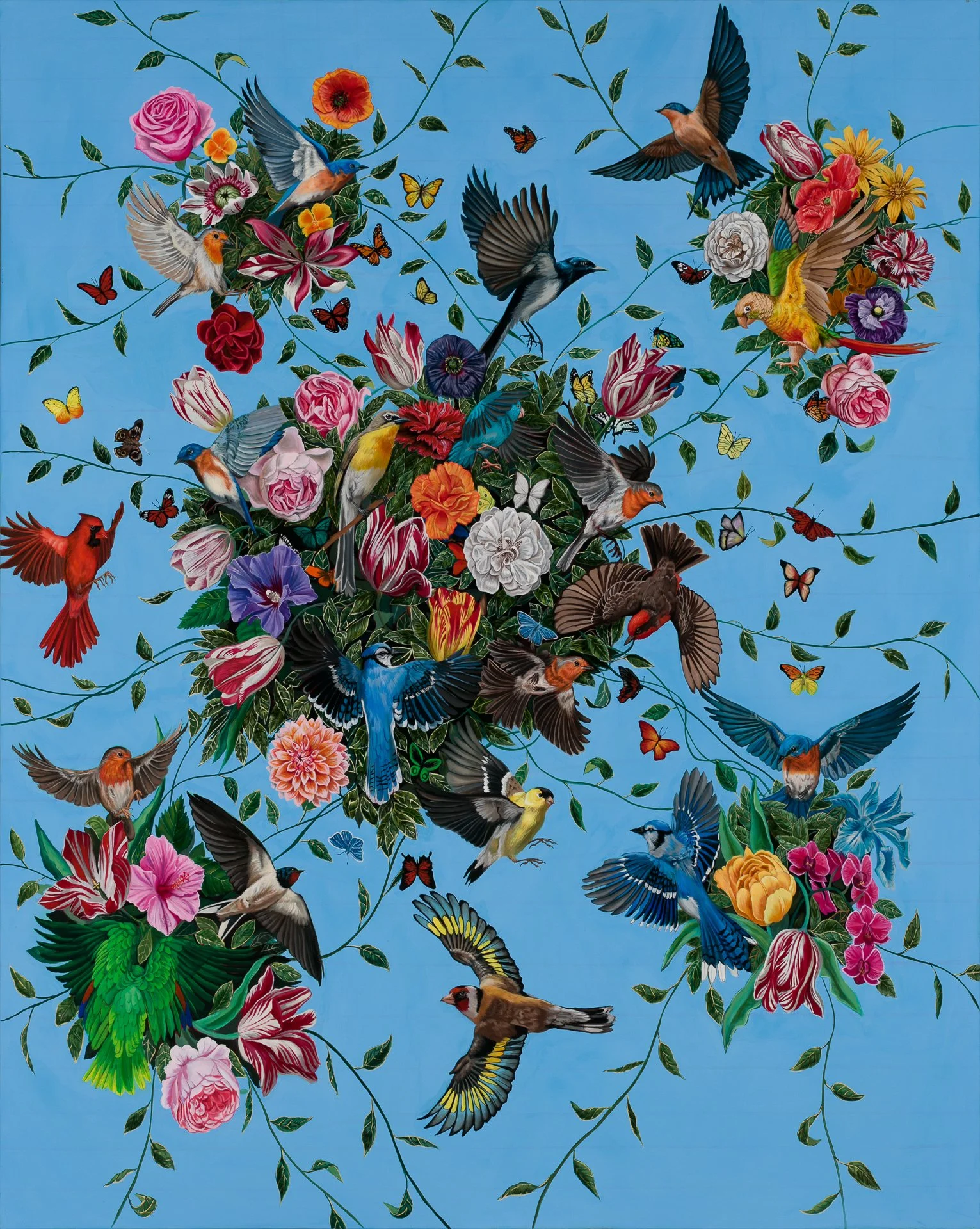
A number of my paintings explore ideas of abundance and utopia through envisioning a world with plenty where both humans and nature thrive. The painting above titled “Open Borders” (60x48 in. oil on canvas) falls in line with this series. I created this painting for an exhibition about immigration at the CVA in Denver. The U.S. regularly commits human rights violations in our response to refugee crises, asylum seekers, and immigration more broadly. I wanted to create a celebratory work about a possible alternative present and/or future. Birds and butterflies are a symbol of migration, and I specifically chose birds, flowers, and butterflies that span across north and South America to comment on the U.S. Mexico border. These walls can keep out human travelers but not birds or butterflies. The floating spheres are self-contained but connected worlds. The flowers represent the possibility of beauty and growth in this new world view. The blue sky and the vibrancy of the colors further supports the beauty and optimism in the piece. I derived inspiration from thinkers like Naomi Klein who argue that “no is not enough” and we have to think about the beautiful possibilities that lie ahead of us if we take the right steps towards supporting each other. This work represents a bright and optimistic future about the possibility of new immigration policies and more generous exchanges between nations.

HYBRIDS
(2016 - 2020)
The conceptual framework for this series of paintings began during the intense political, social, and environmental climate of 2016. These paintings explore the destabilized and uncertain reality of our times by combining disjointed images and painterly vocabularies. They often include animals as subjects in ambiguous and morphing environments. The combination of animal imagery with abstract shapes and unusual colors alludes to the often problematic relationship that forms between natural and constructed worlds. These artworks are simultaneously playful in execution and unsettling in their implications.
On a formal level, these paintings explore the arbitrary divisions between representation and abstraction. A single work may include various degrees of resolution and construction of illusionistic space. Crude drawings stand adjacent to polished and rendered imagery, creating a jarring and even theatrical quality. I derive inspiration from both traditional painting and contemporary artists who push the capabilities of the medium. These artists include Ruprecht Von Kaufmann, Julie Heffernan, Angela Fraleigh, Matthias Weischer, David Schnell, and Sangram Majumdar. I strive to build formal and conceptual juxtapositions that will develop into new possibilities for interpretation and reflection.
FLOOD
(Various exhibitions 2012-2015)
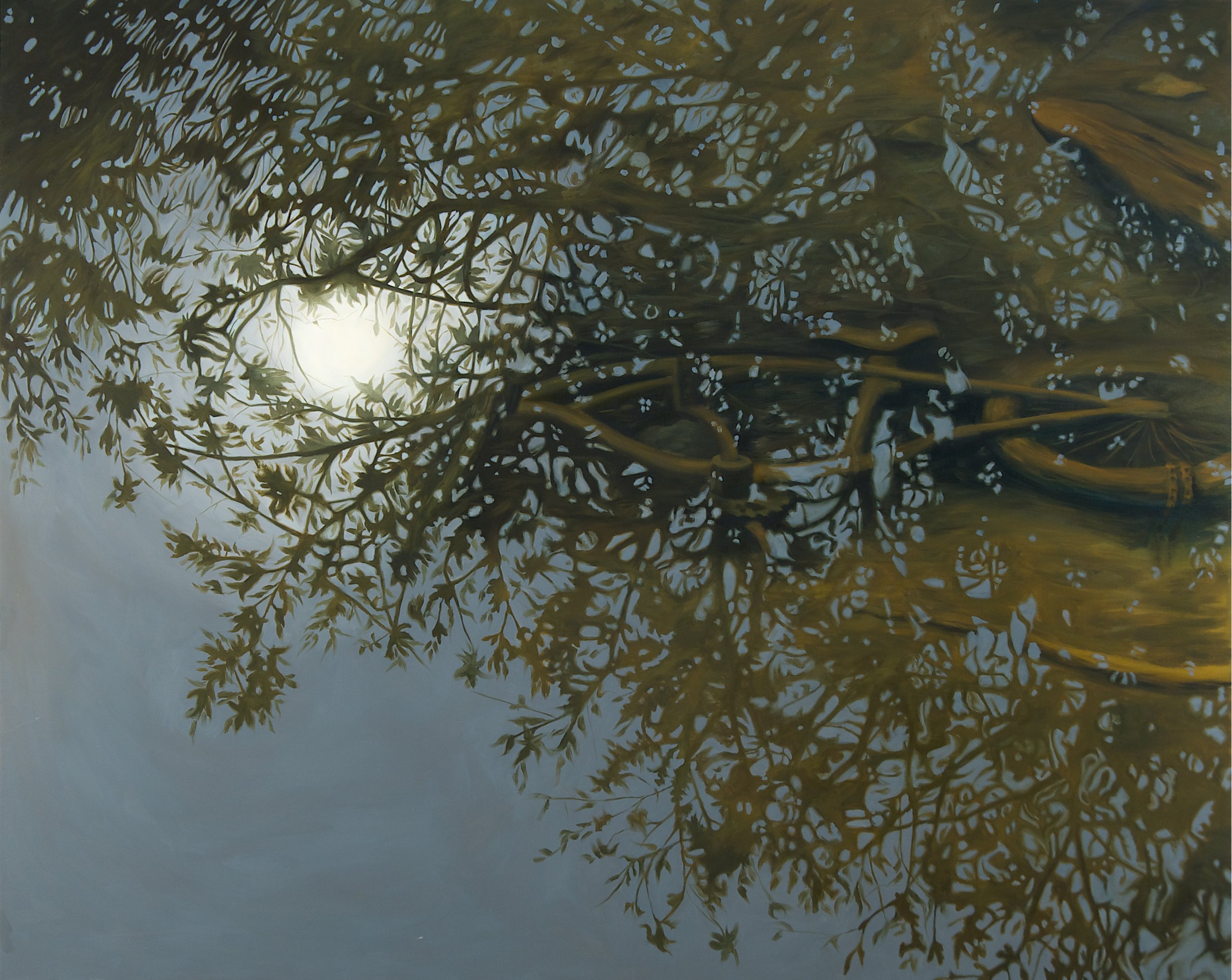
The formal elements of my paintings capture the conflicting visual dualities in water. Water is a substance that can be both transparent and opaque. It allows its mysteries to stay hidden, or to loom eerily beneath its glassy surface. Water also provides an engaging opportunity to explore organized abstraction. Though the work is executed in a realistic manner, a combination of abstract swirls, marks and gestures contributes to the overall image. Many of these paintings allude to the ever increasing incidence of extreme weather events and flooding we have seen due to climate change.
The conceptual foundation of my work stems from water’s creative and destructive duality. It is a substance that can take on a variety of positive and negative connotations depending on its context. This constant state of ambivalence in water emerges in my art. There are no strict narratives. Instead, I seek to provide a visual platform on which viewers can project their own ideas. In a number of paintings, I arrive at these ambiguous narratives by submerging or floating everyday objects on the water’s surface. Universal themes including but not limited to displacement, isolation, transition and loss allow room for a viewer to bring personal experiences to each piece.